

This month: Why private credit was pushed onto investors it was never designed for, how risk never disappears but quietly shifts form, and why the best investors start by mapping the exit.

The Exit Illusion
The market is telling us something in private credit. It’s just not what the headlines would have you believe.
The selloff is being framed as a liquidity mismatch, illiquid assets meeting investors who expected access. That isn’t necessarily wrong. It’s just incomplete.
What’s being repriced isn’t the loan portfolios. It’s the judgment behind them.
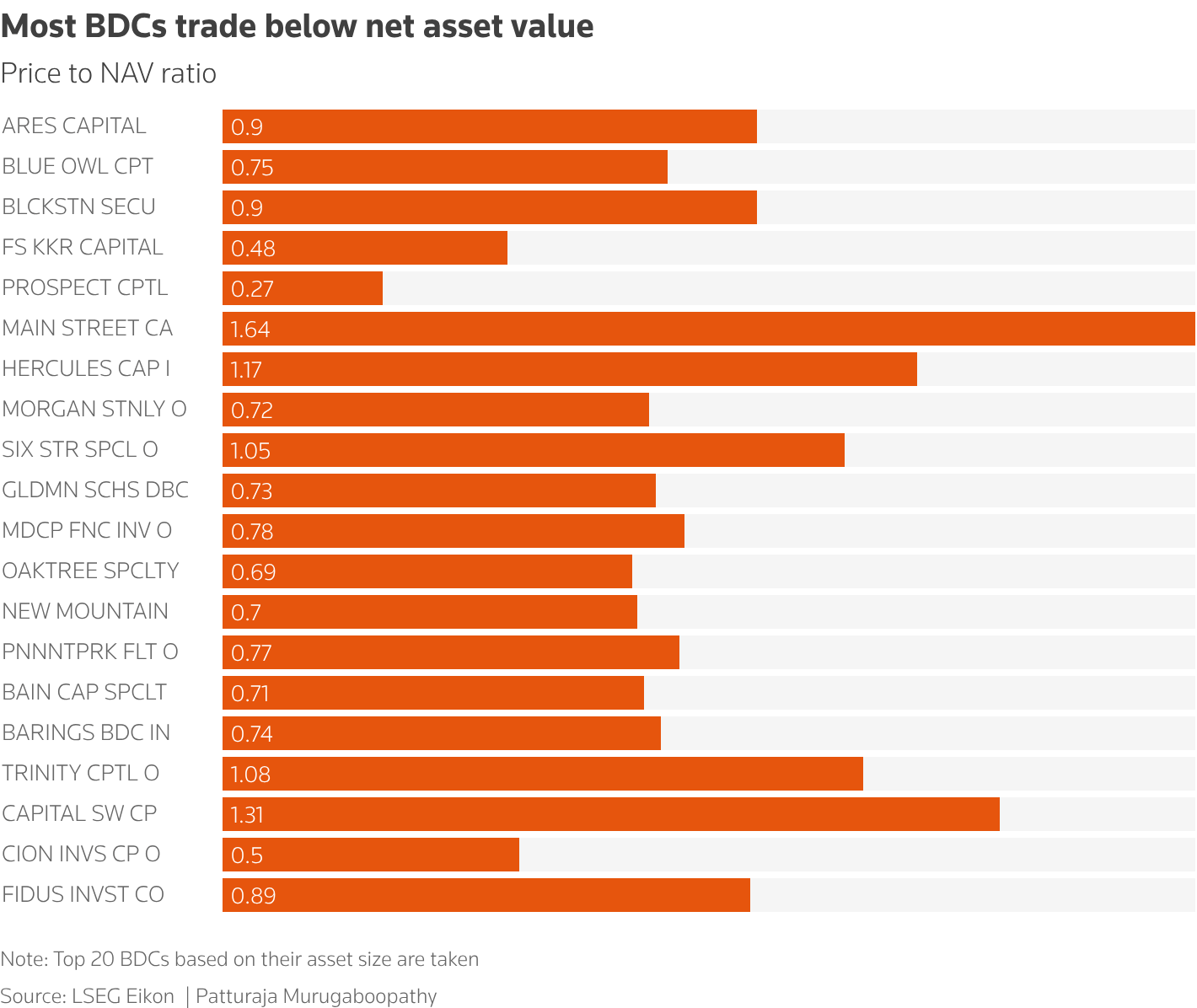
In this market, publicly traded BDCs trading below NAV aren’t signaling distress in the underlying assets. They’re signaling a loss of confidence in the decisions that pushed these products beyond their natural fit.
I’m not saying investors have no part in this situation. Obviously, private credit didn’t end up in retail portfolios by accident. Investors bought it, but at the end of the day, they only bought what they were sold.
At its core, private credit is a straightforward trade. Illiquid assets matched with long-duration capital. You give up liquidity in exchange for yield and stability. There’s no ambiguity in that exchange.
But scale requires growth, and growth requires new buyers. And since they couldn’t change the nature of the asset itself, they changed the positioning and marketing instead.
Private credit was reframed as income with flexibility, stability without volatility, and yield without meaningful trade-offs. The underlying constraints obviously didn’t disappear. But they were softened, reframed, and, in some cases, obscured through creative sales pitches.
“Semi-liquid” structures, periodic redemption windows, and gates were clearly embedded in disclosures. All technically accurate and done by the book. But as we are all seeing, accuracy in fine print and lengthy disclosure is not the same as clarity.
This is where leadership at these companies broke down.
The duty of the BDCs was not to make a private credit product easier to distribute at scale. It was to their stakeholders and to ensure customers understood what they were buying. Instead, investor communications and marketing teams became the drivers of AUM expansion by translating a complex, illiquid product into something that felt broadly accessible to retail investors.
And it worked. That is, until investors wanted the one thing the product was never meant to provide in the first place.
The underlying reality hasn’t changed. These are still illiquid loans. They cannot be sold quickly in size. The structures of the wrappers that held these loans were designed to manage flows under stable conditions, but they can never provide sufficient liquidity if everyone redeems at once.
What we’re seeing now, redemption limits, gated withdrawals, and persistent discounts to NAV in the public markets, is simply put, not a credit event.
It is the bill coming due for a strategy that prioritized reach over investor fit and profits over investor interests, showing up as a real-time referendum on credibility, leadership, and governance.
The industry now faces a choice. Refine the messaging and reset expectations, or acknowledge that these products were pushed beyond their natural audience and rethink where liquidity actually belongs in this product.
I believe the answer isn’t better messaging. It’s in structures where liquidity is priced in the market, not implied within the product.
Markets know how to price risk. It’s what they do. What they won’t do is tolerate a gap between what was sold and what was bought.
Private credit doesn’t have a credit problem. It has a credibility problem.
The Conservation of Risk
I recently heard Corey Hoffstein on a podcast discussing an idea that has been around for decades, but rarely stated so clearly:
"Risk cannot be destroyed, only transformed."
When you start to internalize this concept, I think you begin to see it everywhere. Markets are simply not capable of eliminating risk. Rather, markets are machines designed to transfer and transform it from one type to another.
At the core of every trade is an exchange of risk. One side gives up a risk they don’t want to take. And another accepts it, at an agreed-upon price. The "risk,” however, never disappears. It is just repackaged and redistributed. And sometimes, it’s made harder to see or spread over a larger surface area.
Take a simple portfolio shift, for example. Moving from an all-equity portfolio to a mix of equities and bonds reduces your exposure to economic contraction. But in that process, you are trading some of the economic risk for an increase in your exposure to inflation and interest rates.
Risk doesn’t go away. It moves between forms—price, liquidity, timing, correlation, structure. The label may change, but the exposure doesn’t.
In this portfolio example, you become sensitive to more risks, but less sensitive to any single one.
That is the pattern.
Whenever risk appears to have been eliminated, it has probably just been deferred, redistributed, or disguised.
There really is no version of markets where risk is completely eliminated. Only versions where risk is misunderstood.
Expected return is the price you are paid for bearing risk. If you want less risk, you accept less return. If you want a higher return, you accept more risk.
Investment decisions are not about taking risks. They are about where that risk sits, when it shows up, and whether you’ll recognize it when it does.
From the Field: Find the Exits First
I was in Puerto Rico recently, meeting with an investor who had spent decades in the market. At one point, the conversation shifted, and he told me a story.
He told me how, when he was a young man, he loved to go out dancing at techno clubs. But before he could relax, before he could enjoy any of it, he had a habit. He would walk the room, finding the exits. Not casually, but deliberately. Where are they? How many are there? How fast can he get out in an emergency?
Only then could he settle in and really enjoy himself.
Then he paused and said, “That’s how I invest.”
It was not a metaphor he had polished for recital. It was just how he thinks.
Before committing capital, he wants a lay of the land and a clear understanding of the exits. Not the base case. Not the optimistic projections. Just the exits. Who is on the other side of the trade when things turn? What conditions need to be present for exit liquidity to exist? What happens if everyone wants out at the same time?
Less experienced investors often have a bad habit of starting with their expected return and working backward. He came from the opposite side.
That framing changes the questions you ask. It forces clarity on structure, not just strategy. A position is not just what you own when you are in the trade; it is also how you ultimately leave the trade.
In bull markets, this can feel overly cautious. Liquidity is everywhere. Spreads are tight. There’s always a bid. The exits are clearly marked, so no one bothers to look for them.
Until they aren’t.
What stuck with me was not the story itself, but the reasoning he had behind it. To be clear, I don’t think he looks for exits because he is fearful. He looks for them so he can invest with conviction while he’s in the position.
When you know where the doors are, you can focus more on what’s in the room.
Signal vs. Noise
Liquidity Is Earned, Not Promised — When markets stop taking your word for it, structure gets priced faster than performance. Discounts to NAV are credibility, not credit.
Risk Shows Up Eventually — If it’s not in the price, it’s somewhere else. Usually, in liquidity, timing, or correlation, just waiting for the moment it matters.
Exits Define the Trade — Return is optional. Liquidity is not. If you don’t know where the exit is before you enter, you don’t actually understand the position.
One Last Thing
Risk doesn’t go away.
It gets moved, reshaped, and sometimes hidden. But it’s always there.
The real question is whether you understand what you own before the market forces you to figure it out.
If this letter resonated, I’d love to hear from you. And if you know someone who’d find it interesting, feel free to pass it along.
Until next month,
— Zachary