

This month: The first AI board member is closer than the establishment admits, and a chairman's flat "never" is the tell. AI is quietly repricing how long any company can stay on top. And from NIRI, why regulators can make it cheaper to go public but can't legislate the trust.

The Machine Gets a Vote
We are about to see AI get a seat at the boardroom table. Not a chatbot. Not some sort of tool that a director uses on their laptop. A named AI persona, with a corporate title, a standing seat, and a vote in the room where decisions get made. This will happen at a real company traded on a national exchange within the next 12 months. You will, of course, still have a human to sign things and be held responsible. Because the law still demands that. But for the first time in U.S. public markets, the AI won't be something directors ask questions of in secret. The AI will be seated in the room and contribute directly to governance.
Let me say this again, very simply. The first AI board member arrives this year.
I’ve been thinking about this for a while. But a recent interaction turned my hunch from a thought in the back of my mind to a prediction with a timeframe. A few weeks ago, in a board directors program at UCLA, we asked the former CEO and current board chairman of Target, Brian Cornell, if an AI would ever sit on a public company board.
He answered with one word. "No."
When the chair is so sure that something will never happen, he's probably protecting his seat, not reading the trend. I can’t help but read such an emphatic take as a tell, not a forecast.
This week in Chicago at the NIRI Annual Conference, I had the chance to ask a few colleagues for their opinion. I spoke with a board secretary, senior executives and IR department heads who work directly with their boards and asked them point-blank, “Would an AI director be a net positive or a net negative at your company?” They all said positive, with zero hesitation. I understand that a few people aren't a survey, and I won't pretend it’s anything but anecdotal. But when a Fortune 50 chair says never, and the room says soon, I'll bet on the room.
The mechanics are already solved. Boards are already leaning on AI to digest filings, model out scenarios and pressure-test company strategies. The difference between a tool they consult on their tablet and a member who challenges assumptions, voices concerns, and actually votes is just a title and a definition. Consider what an AI member adds: it reads every word of the board book (instead of just the executive summary), recalls every prior decision ever made, knows every way the company has ever contradicted itself, and has no ego to protect. For a board facing more speed, more complexity, and consequences that arrive in real time, all while drowning in material and short on time, that isn't a gimmick. It's leverage.
The vote itself will be carefully framed. It will be called a recommendation, a steering-committee voice, a position that the humans in the room can adopt or override. But the judgment behind the board’s decision will be the machine's. Giving an AI a name and a seat makes it official.
Named, titled, seated, voting. Here it comes.
What Forever Is Worth
I think AI is creating an enormous amount of value, most of which we haven't figured out how to measure yet. I also think it's a tool, the newest shovel, and that real productivity growth will keep grinding higher at a dependable 2%, the way it has through every prior technological revolution of the last hundred years. I've made that case here before. Both can be true. And neither is the question investors should be asking right now.
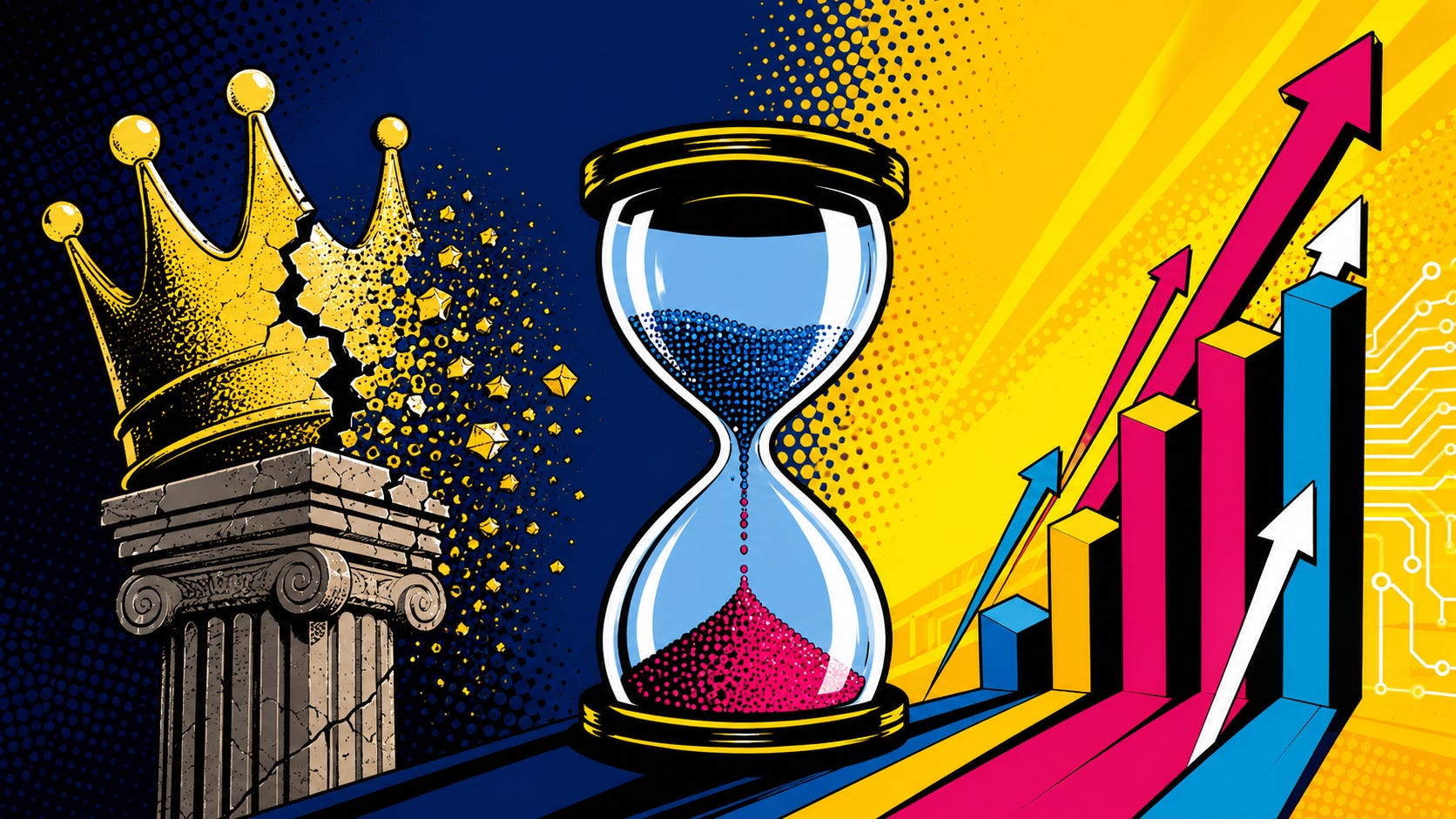
I've written before that a P/E multiple is really a question about time. Five times earnings asks whether a business survives the next few years. And 40 times earnings asks whether it will still be winning decades from now. The higher the multiple, the further out you have to be right. But here's the catch. The far future isn't where most of a company’s value lies. Cash flows distant enough, discounted back to today, round to almost nothing. A company earning predictably for the next 100 years is worth about the same today as if it were to go on earning forever. So, a high multiple today doesn't really pay for "forever." It's actually paying a premium for the durability of the next 10 or 20 years. That stretch is where everything gets valued.
And that's the stretch that AI actually threatens. Here's where the debate looks wrong. Everyone argues about the AI companies, whether the spending pays off, and whether the returns will ever justify the hype. The real question is not about what happens to AI-adjacent names; it’s what it does to everyone else. Not just software, and not just the thought-work jobs people already agree are exposed.
If you listen to the talking heads on CNBC, they often repeat the same tired—and inaccurate—tropes. That financial planners should be worried about AI taking their jobs, but that plumbers and massage therapists are somehow safe, because you can't automate a pair of hands. I don't buy it. Why the hell can't a robot swap out a toilet, or give a better back rub than a tired human at the end of a long day? Of course it can, eventually. "AI-proof" isn't a moat. It's a runway people are not appropriately repricing yet.
So the same technology creating all that hard-to-measure value can also be quietly re-rating almost everything else. Strip it all down, and virtually every rich valuation multiple is just a bet on how long a company stays on top, and AI is shortening that time horizon across the board. A gift to a few companies, no doubt. But perhaps also a tax on every company priced for permanence. The repricing that matters isn't the loud kind, a new entrant or a sharper product. It's the market quietly marking down how long it will believe anyone stays relevant.
But shorter runways and lower multiples aren't always a sign of a shrinking pie. The 2% will find a way to keep on grinding, because the same force compressing today's moats is already handing the next picks and shovels to someone new. Obsolescence in one industry becomes a moat in another. What's shrinking isn't the total value. It's how far out we can underwrite any single name. The premium for permanence comes down everywhere. The building never stops. It just keeps changing hands.
From the Field: The Chairman's Shrug
At NIRI this week, SEC Chairman Atkins took the stage. Most of his energy went into pitching his plan to "Make IPOs Great Again," by which he means cheaper to go public and faster to raise capital. The SEC's latest proposal would even let a company tap an S-3 shelf the day it lists, rather than waiting the usual year. With SpaceX public as of Friday, and more AI behemoths still to come this year, the timing is worth noticing.
Then someone asked about 13F filings (the quarterly disclosures in which big institutional investors list the U.S. stocks they hold), about giving issuers more visibility into who actually owns their stock. The energy drained out of his answer. Aloof, noncommittal, the long-winded non-answer you'd expect from a politician.
The contrast was stark. The whole agenda is built to make it cheaper to go public and faster to sell stock. The one reform that would help a company actually know who its owners are gets a shrug. We keep widening the exits, yet companies still can't see who's coming and going.
Signal vs. Noise
The Loudest Denial — A named, voting AI director joins a US-listed boardroom this year. When the establishment is loudest about "never," it's usually closest to "now."
Borrowed Time — AI isn't erasing value, it's shortening its shelf life. The durability the market pays a premium for is quietly draining from today's giants toward tomorrow's.
Cheap, Not Understood — Regulators can make going public cheaper and the exit faster. They can't legislate trust, and the reform that would help companies know their owners keeps getting skipped.
One Last Thing
Soon, an AI will read more, recall more, and miss less than any director in the room. So why keep a human in the chair? The law still needs a name to blame. We used to seat directors for their wisdom. Now, for their liability.
If this letter resonated, I’d love to hear from you. And if you know someone who’d find it interesting, feel free to pass it along.
Until next month,
— Zachary