

This month: Why the difference between persistence and ruin is just math. We unpack the 63% Rule and what it teaches about odds, effort, and inevitability; explore how leadership communication must adapt to an age of fractional attention; and examine why every company eventually opens its Surprise Box — and how to make sure what’s inside doesn’t end you.

The 63% Rule: Persistence Masquerading as Luck
Most lucky breaks are just math with a work ethic.
If something has a 10% chance of happening and you try ten times, the odds that it happens at least once are about 65.1%. Make the odds smaller, a 1% chance repeated 100 times, and the likelihood of at least one success becomes 63.4%. Take it even further: a 1-in-1,000 event repeated 1,000 times yields almost exactly 63.2%.
This convergence is not a coincidence. The 63% Rule, a quiet constant of probability, shows that when the number of attempts equals the inverse of the odds, the likelihood of at least one success approaches 1 − 1/e, or 63.2%. Mathematically, it is expressed as P(success ≥ 1) = 1 − (1 − p)ⁿ, where p is the probability of success and n is the number of tries. Psychologically, it is why persistence looks like luck.
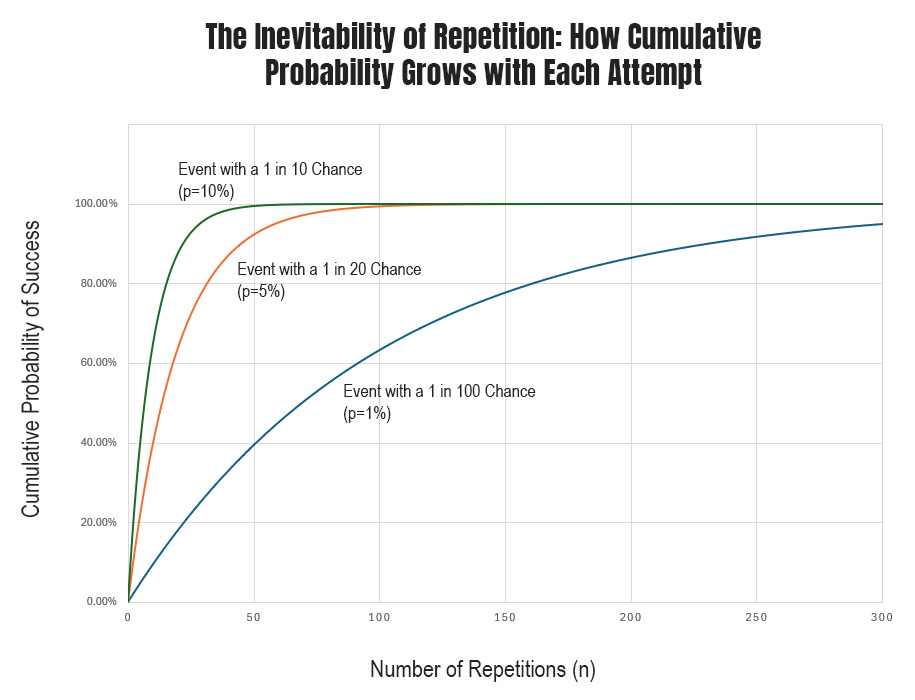
Try something with even a slight chance of success enough times, and it becomes nearly inevitable. Founders pitching investors, product teams testing new features, authors querying publishers, and sales teams chasing enterprise accounts all live by this rule, whether they know it or not. A small business might send 500 cold emails to land one key customer. A novelist might collect 200 rejections before finding a publisher. The odds in each case may be low, but persistence turns possibility into probability.
That is the bright side of the 63% Rule. It rewards motion over mastery and shows how repetition converts chance into momentum. Over time, what looks like luck is simply probability catching up with consistency.
But the equation doesn’t care what actions you repeat in pursuit of an outcome. The math doesn’t make moral judgments.
If an action carries a 1-in-1,000 chance of disaster, such as a safety lapse, a compliance breach, or an unhedged position, and you take that risk 1,000 times, you give yourself a 63% chance of ruin. At 5,000 exposures, the probability jumps to 99%. With enough repetitions, even unlikely events become inevitable.
This is the quieter half of the persistence story, the math of fragility. It explains why traders blow up after long winning streaks, why supply chains collapse after years of smooth operation, and why safeguards fail when they’re needed most. The same repetition that builds wealth, scale, and safety, if misapplied or hiding even a slim chance of ruin, eventually ensures collapse.
The 63% Rule doesn’t pick sides. It rewards discipline and punishes recklessness with the same precision. What matters is not just how often you act, but what you choose to repeat. The small positive behavior that compounds toward success, or the small hidden risk that compounds toward ruin.
In the end, the difference between persistence and ruin isn’t just about the odds. It’s about awareness — knowing which side of the equation you’re on — and having the discipline to stay there.

Micro-moments, Macro Effects
Investor updates, CEO interviews, internal town halls, and even press release headlines are now built for consumption in micro-bursts. The clip that gets shared, the quote that trends, and the chart that fits on a phone screen now shape the entire story. We’ve entered the age of fractional attention, where understanding is measured in impressions, but consequences still unfold over years.
That gap between short attention and long horizons is where modern leadership now operates. Markets price companies every minute, yet they judge them over decades. A single offhand comment on CNBC can move billions in market cap, while it may take years to rebuild credibility after a missed promise. The medium has changed, but the cost of inconsistency has not.
In this environment, clarity is no longer a style choice. It is risk management. The organizations that win the micro-moment game don’t talk more; they talk truer. Apple’s leadership favors minimal language but maximum consistency. Nvidia delivers complex ideas in clean, repeatable narratives. The best communicators treat every statement as a small bet on trust, each one nudging sentiment up or down.
For communicators and investors alike, the playbook has flipped. The old rule said to save your message for the big stage. The new rule says every moment is the big stage. The casual post, the one-line quote, the hallway video, are now inputs to market psychology.
The challenge is not brevity. It is coherence. Can you compress a decades-long strategy into thirty seconds without losing integrity? Can your micro-moments add up to a macro-truth?
The leaders who can will define the next era of market storytelling. The ones who can’t will keep wondering why the world stopped listening after the headline.
From the Field: The “Surprise Box” Leadership Risk
Most leadership teams spend their time managing the risks they can name. Earnings shortfalls, supply chain hiccups, and reputation management are all built into the plan, forecast, and narrative. But the events that truly change careers and companies rarely come from what is visible. They come from what no one saw coming.
The real shocks are the unmodeled ones — a breach traced to a forgotten vendor, a cultural issue that turns into a crisis before leadership even knows about it, or when your CEO and HR director attend a Coldplay concert together. These are the blind spots that undo strategy, not because they were unmanageable, but because they were unimaginable.
When the box opens, the only play that works is honesty at speed. As Scott Galloway puts it, crisis response has three steps: acknowledge the problem, have the top person take responsibility, and overcorrect so it never happens again. His version is often less polished but exactly right, and looks like this:
“We fucked up. I mean REALLY fucked up. I take full responsibility. Within 48 hours we will produce a definitive plan for ensuring this never happens again. Finally, see point 1 — we fucked up.”
That kind of radical candor is rare because it feels dangerous. But it’s also the fastest path back to credibility. The best-run firms don’t aim for immunity. They build reflexes. They decide who speaks first, how transparency scales, and what credibility sounds like under pressure.
Signal vs. Noise
Persistence Premium — People will always mistake consistency for luck. The winners aren’t special. They’re just the ones who stay in the game long enough for probability to catch up.
Compression Risk — Messages are getting shorter, but the consequences last just as long. The leaders who mistake brevity for clarity are the ones most likely to be misunderstood.
Prepared is the New Transparent — Surprise is inevitable. Unpreparedness is not. The companies that rehearse their worst-case scenarios are the ones investors will eventually reward.
One Last Thing
Progress rarely comes from revelation. It comes from people who keep showing up, saying what they mean, and holding steady when the odds or the crowd turn against them. The math, the message, and the moment all reward the same instinct: composure in motion.
If this letter resonated with you—or you want to keep this conversation going—I’d love to hear from you.
Until next month,
— Zachary