

This month: Why the “obvious short” is often a bet on liquidity, how valuation multiples quietly encode how far into the future investors must be right, and where management narratives finally collide with investor models.
The Obvious Short Is Really a Liquidity Bet
Some shorts look so obvious they barely require financial modeling. The business is failing, the balance sheet is upside down, and the maturity wall is rapidly approaching. The path to zero is almost mechanical.
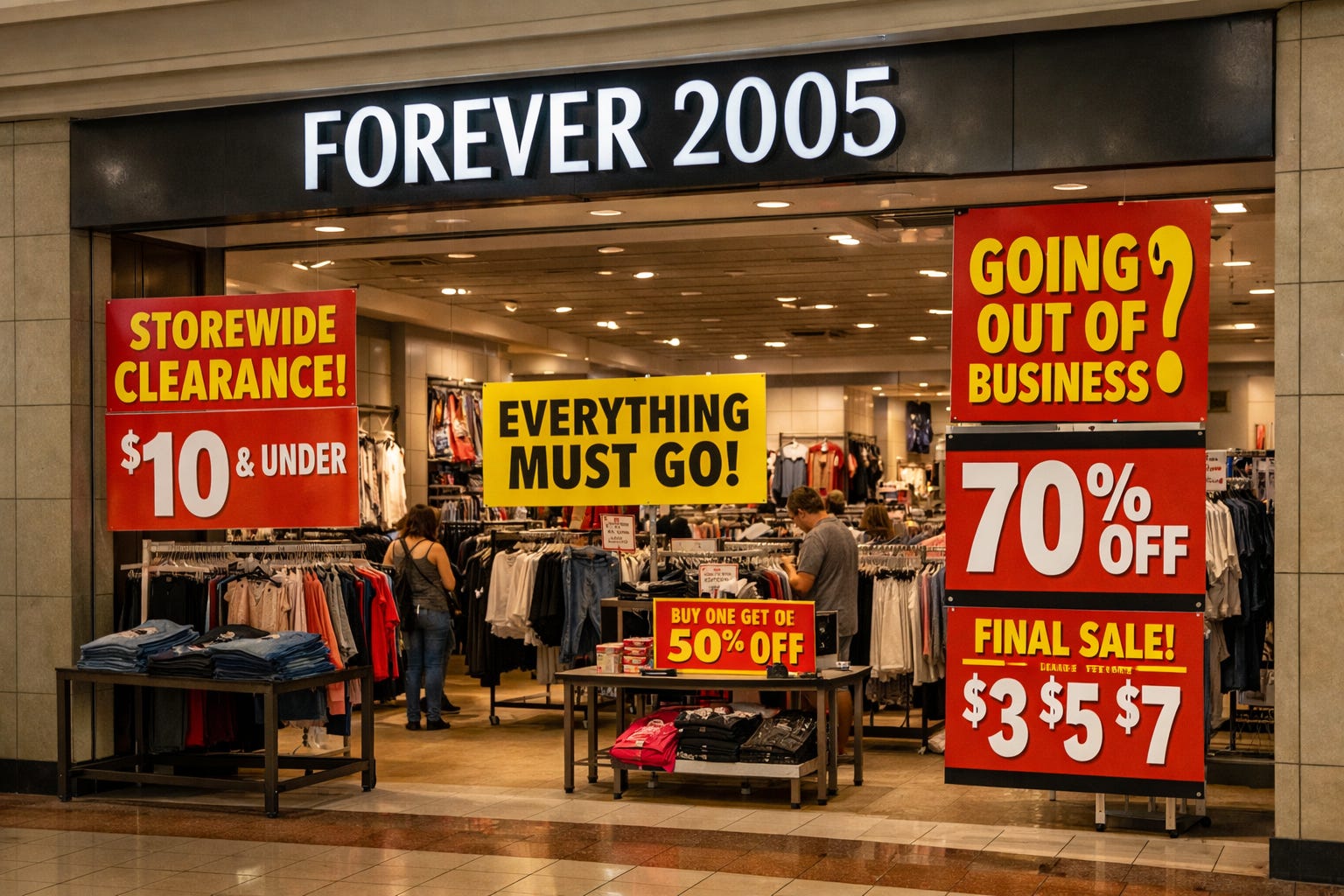
Let’s consider a hypothetical company. We’ll call it Forever 2005.
It’s a large mall-based clothing store whose best years came when phones still had keyboards and high school classrooms smelled like Abercrombie & Fitch. Store traffic has been falling for years. Same-store sales are negative. Management has been closing locations and cutting costs, but revenues continue to slide as shopping moves online and U.S. malls slowly fade into the past.
The balance sheet tells the story. Forever 2005 carries $1.2 billion of debt, and its bonds trade around 40 cents on the dollar. Yet the equity still has a $120 million market value. Zoom out on the stock chart, and you’ll see the same thing — the stock has been drifting down and to the right for years.
For many investors, this setup looks like the perfect short. The business is declining, the capital structure is upside down, and debt maturities are approaching. Malls are dying a slow, painful death, and Forever 2005 isn’t going to suddenly lead a retail renaissance. Eventually, the company will run out of runway, and when lenders force a restructuring, the equity will go to zero.
It’s just math.
But that framing misses something incredibly important.
When investors short a company like Forever 2005, they think they’re betting against the business. In reality, they’re betting against the capital markets.
And capital markets are rarely as simple as short sellers expect. Lenders are not liquidators. Liquidation locks in losses. Extension creates optionality. A lender holding bonds at 40 cents does not actually need the business to succeed to dramatically improve recovery values. Survival alone changes the math.
When you begin to understand this, the role of equity starts to look very different. Instead of representing ownership in a struggling retailer, the stock behaves more like a call option on survival. Its value isn’t driven by the current operating performance so much as the probability that the company can extend its runway.
Capital markets have a funny way of extending the runway when you least expect.
Imagine Forever 2005 reports a quarter that is simply less bad than expected. The stock rallies from $2 to $6 as short sellers are forced to cover and trading volume explodes.
And what does management do? What any rational management team would do: they dump ATM shares into the rally as fast as they can!
With newfound liquidity on the balance sheet, the company begins buying back debt at distressed prices, pushing out near-term maturities. Credit markets respond. Bonds jump from 40 cents toward 70 cents on the dollar, and the company’s runway suddenly looks a whole lot longer.
The underlying business has not improved, malls are still fading away, stores are still struggling, and Forever 2005 is still a shitty business built for a time gone by.
But the capital structure has improved, liquidity has increased, and the probability of an imminent bankruptcy has declined.
In situations like this, the most valuable asset, one you won’t find on the balance sheet, is time.
This is the trap. With so many so-called “obvious” shorts, the investor believes they are betting against a failing company. In reality, they’re betting on something else entirely: whether the company can restructure its capital before the clock runs out.
Sometimes that bet works out exactly as expected. But sometimes the market opens a window, the company buys time, and the entire trade gets reset.
The short thesis was not wrong about the fundamentals.
It was wrong about how the capital markets behave.
What Is Price Asking?
Investors spend a lot of time debating whether a stock is cheap or expensive. But rather than view price as a statement, I think it’s helpful to reframe price as a question.
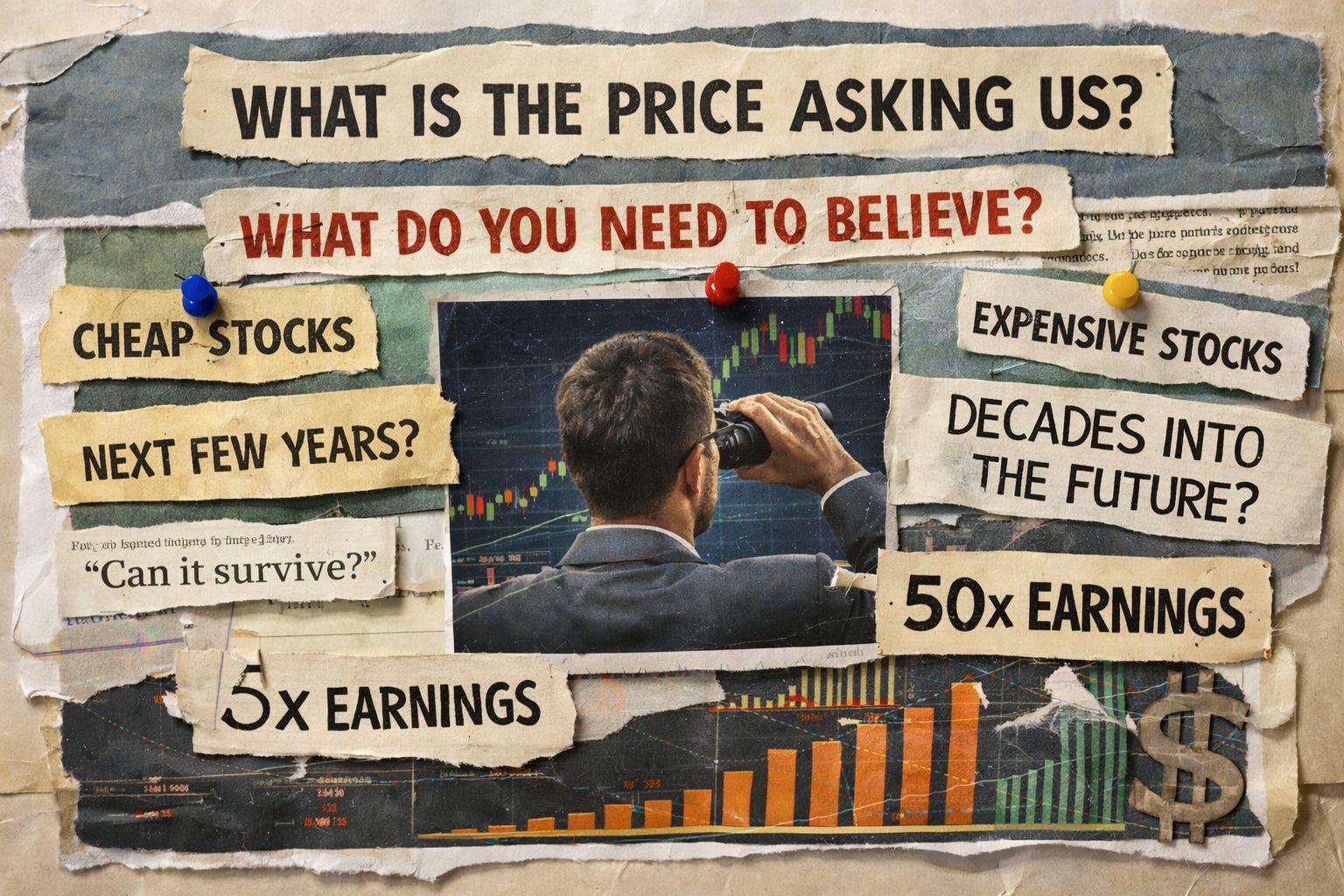
What is the price actually asking you to believe?
I have a very simple way of thinking about valuation multiples. A way that completely reframes the idea of cheap vs. expensive. It’s not perfect finance theory, but as a heuristic, it’s surprisingly powerful.
Think of a P/E ratio as roughly a proxy for how far into the future you are being asked to believe in the merits of a business.
A company trading at 3x earnings is asking a fairly simple question. Do you believe the business can maintain today’s performance for the next few years?
At 10x or 12x earnings, the timeline stretches a bit. Now the price is asking whether the company can remain stable and relevant over the next ten years.
But once a company trades at 40x or 50x earnings, the question looks very different. In a basic sense, you are being asked if you believe that the business will remain relevant, profitable, and competitively intact for a number of decades out into the future.
I believe this realization can be incredibly powerful for many investors.
Because while most of us can form a reasonable view of a business’s prospects two or three years out, and sometimes even five or ten years out, virtually nothing in life is predictable over many decades into the future. Industries evolve, technologies shift, and moats erode.
Obviously, the math here isn’t really quite this simple. Earnings might grow, capital gets reinvested, and valuation multiples can compress over time. A company trading at 50x earnings today does not necessarily require 50 years of stability for the investment to work.
But the heuristic captures something important.
Valuation hints at how long your assumptions need to survive.
Which leads me to an interesting observation about certain companies trading at very high multiples.
Take Costco, for example. The company is currently trading at 50x forward earnings, a nosebleed level traditionally reserved for high-growth technology companies. But I suspect very few investors would argue that Costco’s valuation today reflects explosive growth expectations tomorrow.
I believe the multiple reflects something very different: an unusually high level of confidence in the longevity of the business's durability.
Investors cannot know for certain what Costco’s earnings will look like 30 years from now. But right now, today, they appear incredibly comfortable that the model itself — membership economics, relentless cost discipline, and customer loyalty — will still be working decades into the future.
In that sense, the multiple may not be saying Costco will grow. It may just be saying investors are comfortable underwriting the business well into the future.
That’s the message embedded in price.
Cheap stocks ask whether a business can survive the next few years. Expensive stocks ask whether the story will still make sense when your kids are grown.
The higher the price, the further into the future the market is asking you to be right.
From the Field: Where Stories Meet the Model
I was sitting in a meeting recently between a management team and a group of investors when something familiar happened.
Management spent the first 20 minutes describing the servicable market, the strategic positioning, and where the company could be in 10 years.
And then, the first investor question was about last quarter’s operating margins.
I’ve noticed that in conversations between management teams and investors, two very different ways of thinking about the business often collide.
Management generally likes to tell the story from the top down. They describe the opportunity, the positioning, and where the company believes it will end up.
And analysts like to approach from the other side. They assess the business from the bottom up — modeling same-store sales, pricing power, margins, and costs to predict what might happen over time.
Both perspectives are necessary. But they are in no way the same. A strategy explains where the company is trying to go. A model tests whether the explanation is possible.
Eventually, those two viewpoints have to converge.
And more often than not, where they meet is in the financials.
Over time, the market has a nasty habit of forcing the top-down story to reconcile with the bottom-up math. If the strategy is real, valuations grow. If it isn’t, gravity sets in.
At the end of the day, a stock’s price will be where the narrative and the math decide to agree.
Signal vs. Noise
The Trap in “Obvious” Shorts — The short often looks like a bet against the business. In reality, it’s a bet that capital markets stay closed long enough for the math to matter.
Multiples Measure Time — An earnings multiple isn’t just price. It’s a statement about how long your assumptions need to survive.
Narrative vs. Math — Management explains the future through strategy and narrative. Investors test those ideas through assumptions and models. Over time, the financials force those perspectives to converge.
One Last Thing
Markets are designed to process a hell of a lot of uncertainty.
But that uncertainty leaves room for interpretation. Management talks about strategy, positioning, and where the business might go next. Investors build models and try to predict what the numbers might look like.
For a while, those two views can seem to exist in parallel.
But markets have a way of forcing those views to intersect. Eventually, the question embedded in the price meets the answer embedded in the financials.
And somewhere between the story and the model, the stock price reveals which view was closest to the truth.
If this letter resonated, I’d love to hear from you. And if you know someone who’d find it interesting, feel free to pass it along.
Until next month,
— Zachary