

This month: How executives are leveraging the promise of AI to mask a structurally frozen labor market, the mathematical advantage of doing absolutely nothing during a macro earthquake, and why defensive, compliance-obsessed boardrooms are practically inviting activists through the front door.

The Illusion of Revolution
The market loves a simple narrative. Right now, Wall Street is selling the idea that AI is a tear in the fabric of economic history, a shift so staggering that it will forever change corporate efficiency and usher in a golden age of margin expansion.
Let’s zoom out on this idea.
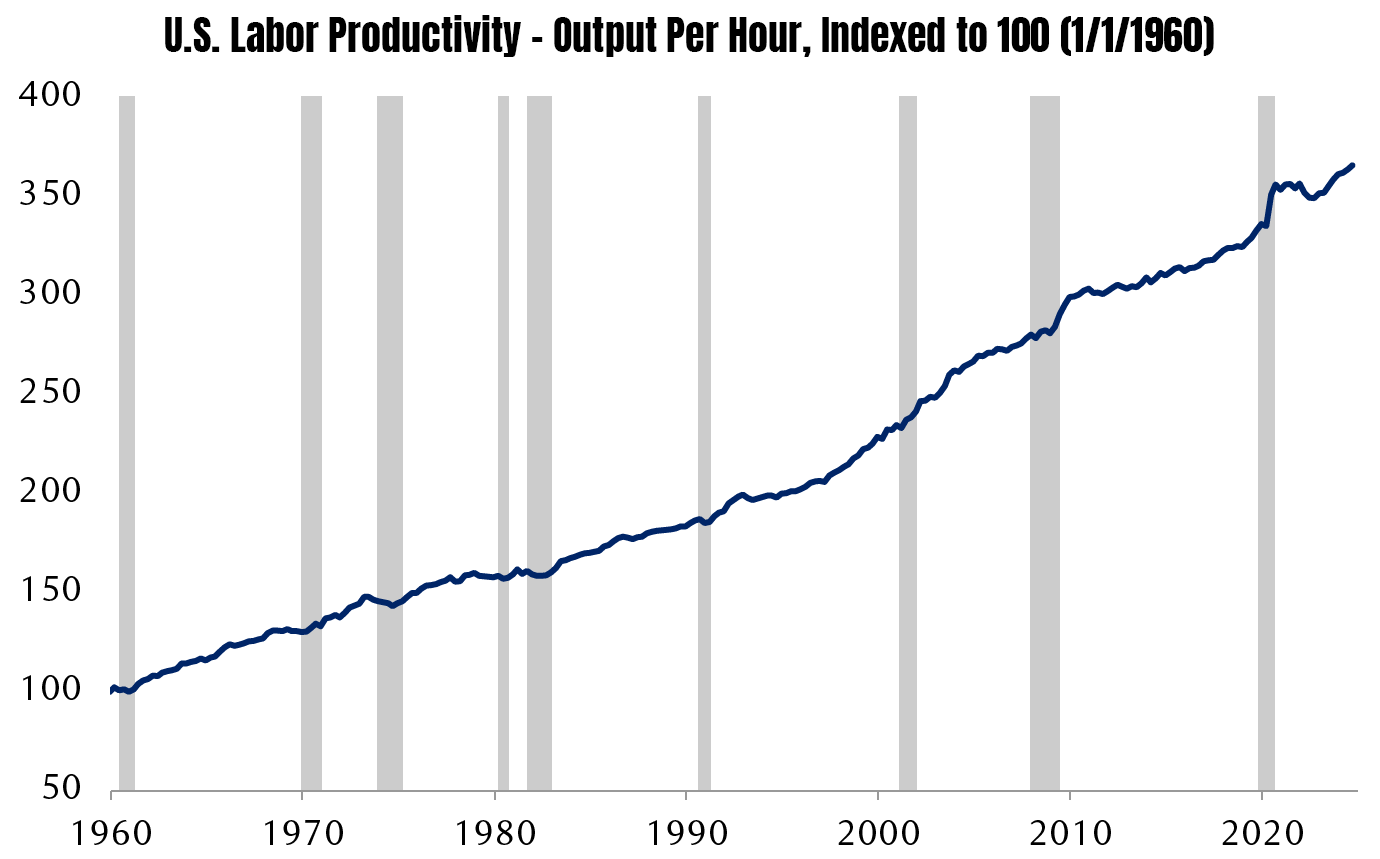
Take a look at a chart of US labor productivity growth over time, and you’ll see it compounds at a rather predictable 2% annual rate. It’s a slow, methodical, and painfully predictable grind higher. If I presented the same chart without the dates, you couldn’t pinpoint the invention of the personal computer. You could not find the dawn of the Internet. And you sure as hell couldn’t find the year Steve Jobs gave us the iPhone.
In the moment, every new technology feels like magic that will change everything forever. But, on a long enough timeline, innovation tends to look a lot more like business as usual. AI isn’t a magic wand. It is a foundational utility. Like the internet before it, AI is the new infrastructure on which the next fifty years of growth will be built.
Don’t get me wrong. AI is a generational shift that is undoubtedly rewriting the rules of the road. But if history is any guide, there is a big difference between breakthrough and assimilation. The reason you can’t find the internet on the chart above isn't that it lacked impact. It's that the world takes decades to harness the power of a technological leap. Restructuring a global labor force does not happen overnight.
While Wall Street is busy leveraging the promise of AI to sell magic wands, underperforming executives are using it as a convenient rug to sweep their past mistakes under.
We are witnessing an epidemic of AI-washing in the labor market. CEOs who overhired and spent the zero-interest-rate era expanding their labor force are now quietly course-correcting with targeted layoffs. But rather than admit they over-hired into a demand bubble, they drop the phrase “AI-Driven Restructuring” into a press release. This isn't just an observation. This is the playbook. They sit in a room, cross out “bloat-reduction,” replace it with “technological efficiency,” and let the buy-side algorithms do what they do best.
They turn to this PR spin because they are actually terrified of the underlying reality: the traditional economic engine is currently paralyzed.
Normally, the sequence of an economic cycle is fairly predictable: Housing, Orders, Profits, Employment (HOPE). But right now I feel like the cycle is broken. Housing velocity is essentially at zero, trapped by an entire generation of homeowners sitting on 3% mortgages who have no desire to trade their cheap debt for today’s rates. Orders are being distorted by eye-watering capex—with the Mag 7 tech giants spending incredible sums. Corporate profits are stronger than ever, at least in part subsidized by that same capex tech spending as it trickles from vendor to vendor.
That leaves us with Employment. If you just skim over the headline jobs numbers, everything looks great. A soft landing has been achieved. But dig in a little deeper and you’ll see these numbers are being propped up by healthcare—one of the most bloated and heavily subsidized sectors in the economy.
Strip out healthcare, and the jobs market is simply stagnant. We have essentially entered the “no-hire, no-fire” economy. Employees aren't changing jobs because market opportunities look a little thin, and employers aren't doing massive layoffs because they are still recovering from the PTSD left over from COVID-era expansion, followed by the post-pandemic squeeze.
With virtually no organic economic momentum and a flatlined labor market, executive IR and comms teams are getting creative. With all the AI investments, they can’t lean on top-line velocity. So they trim a little fat, slap on an ‘AI-Driven Restructuring’ label, and serve it up to the bots as technological evolution.
This is certainly not a recession. A recession requires a true contraction. What we have right now is a structural freeze.
The danger for investors is buying into an illusion of momentum. To win in a frozen market, you have to look past the noise. The real signal isn't a C-suite waving a magic wand on an earnings call. It is the executives who understand that even revolutionary technology requires long-term thinking.
Day-Trading Earthquakes
Risk and uncertainty never actually disappear. They just change forms. Risk in markets is a feature, not a bug. Risk is the non-negotiable price of admission. Markets pay you a premium precisely because the future is scary. If you remove the risk, your returns collapse to the risk-free rate.
What the masses often miss is that, while headlines have certainly gotten worse over the last year, the math for forward returns has improved. When fear is abundant, multiples compress. But if the underlying corporate earnings keep grinding higher, as they have recently, you suddenly get to buy the exact same cash flows at a discount. The market is not in the business of rewarding the fearful. It’s in the business of rewarding those who correctly price the fear of others.
This is the heart of the single greatest edge you can have in the markets: the luxury of not having an opinion.
Portfolio managers face a structural disadvantage. They are graded quarterly. If a crisis flares up, they have no choice but to act, to hedge their exposure, to rearrange the deck chairs, to prove to their LPs that they are not asleep at the helm.
But you don't have to do any of that. You are not being graded on how accurately you can predict the price of crude, the outcome of swing-state elections, or whether a ceasefire will hold through the weekend.
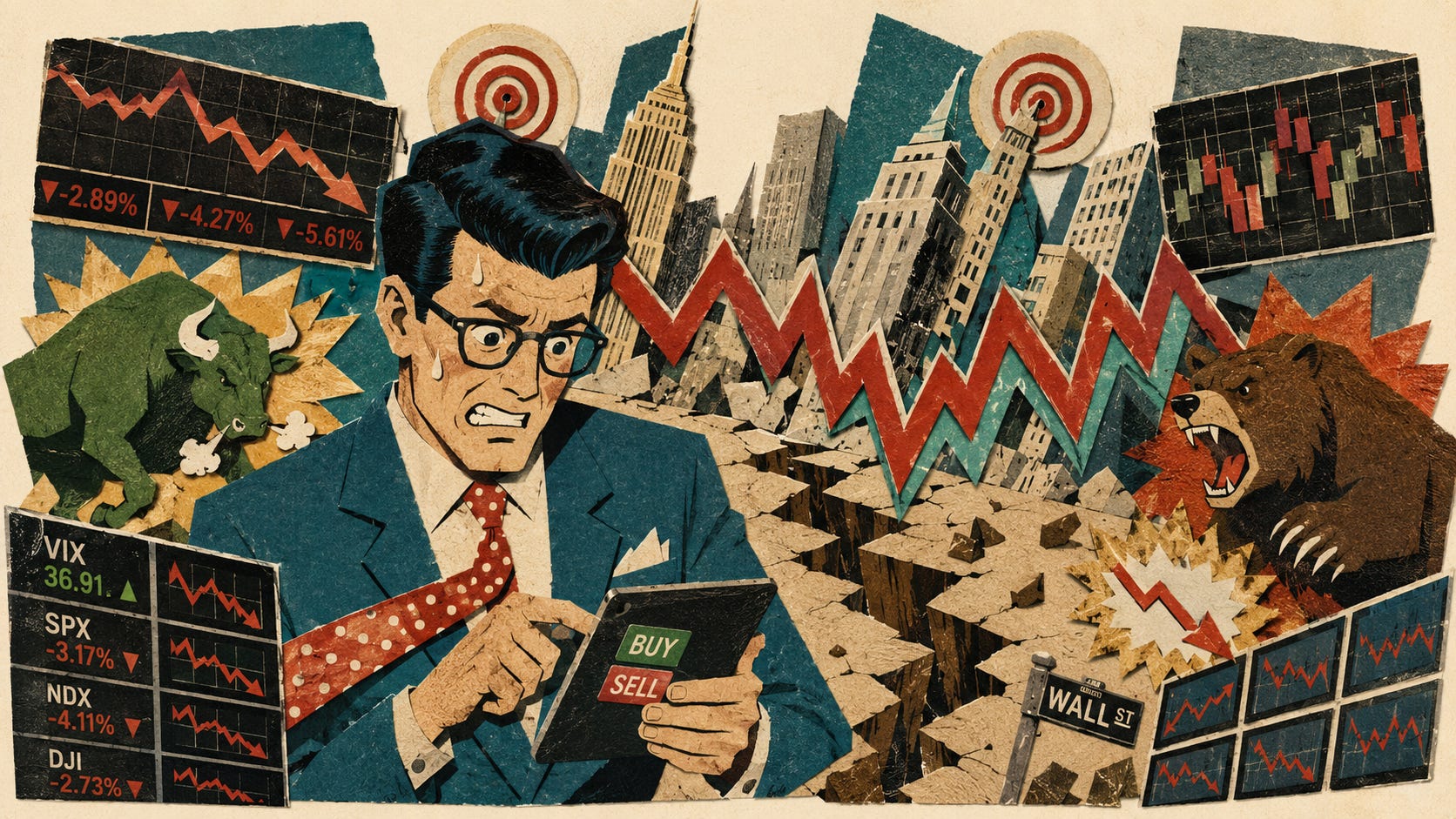
Trying to trade the macro environment is like trying to day-trade an earthquake. You will never see the tremors coming, and even if you get lucky, you will almost certainly get destroyed by the aftershocks. The analysts who get paid millions to forecast the macro economy aren't bad at their jobs. They are just playing a game that cannot truly be won.
Mike Tyson once famously said that everyone has a plan until they get punched in the mouth. The market’s equivalent is that everyone is a long-term investor until the market breaks their nose. The real edge isn't in having a crystal ball. Edge comes from knowing exactly what you own and establishing rules before the crisis hits. If you try to improvise when the headlines get scary, you are far more likely to make the worst decision at the worst possible time, like capitulating at the bottom and locking in permanent damage to your portfolio.
The playbook is simple. Set your rules when the market is boring, and refuse to flinch when the chaos hits. Let the institutions panic. Let the algorithms overreact to the headlines. Let them compress the multiples and put the market on sale for those with the stomach to endure the ride.
From the Field: The Activist's Invitation
I spent last week in Los Angeles, embedded in the UCLA Board Directors Program. Between the boardroom simulations, strategy breakouts, and candid sessions with leaders like Target Chairman Brian Cornell, the days were intense 12-hour sprints. But one of the biggest takeaways for me last week wasn't in the curriculum. It was watching a long-held suspicion of mine get validated in real time.
I have argued for years that investor relations and strategic communications are dangerously underrepresented at the board level. My experience this week absolutely reinforced that reality.
During a NomGov session, the focus inevitably turned to the board skills matrix. Modern boards are obsessed with checking boxes. They want a cybersecurity expert. They need an ESG consultant to navigate scope-emissions disclosures. They want a 'digital transformation' guru to prove they understand AI. And of course, every board needs a former Big 4 auditor!
In stark contrast to that defensive posture, a separate strategy session with David Wessels highlighted the quiet truth of executive leadership: the single most important role of the CEO is ensuring capital flows to the most effective part of the enterprise.
Put those two ideas together, and you find the gaping hole in many modern boardrooms. In the rush to fill the matrix, boards often forget to include an owner-investor perspective in the room.
Because that mindset is missing from the table, there is often no one sitting there whose sole instinct is to look at a strategic plan, strip away the rhetoric, and ask the brutal allocator question: Is this actually worth our capital, and how exactly will the street digest it?
Boards don't solve problems. They shape how problems are solved. If your board composition is entirely defensive, your strategy will be too. And if you refuse to invite an aggressive, owner-minded capital allocator to the table willingly, an activist investor will eventually kick the door down and install one for you.
Signal vs. Noise
AI-Washing — C-suites are using "technological efficiency" to gloss over a frozen labor market. Look for the operators quietly working to raise their productivity average without the theatrics.
The Volatility Trap — Institutional investors can be forced to rearrange deck chairs during market chaos. The advantage to retail is having the option to do absolutely nothing but search the bargain bin when the market goes on sale.
The Boardroom Blind Spot — Corporate boards can become obsessed with checking boxes rather than digging in and getting technical about capital allocation. If you don't invite the owner-investor perspective to the table, an activist will do it for you.
One Last Thing
If there is a central takeaway this month, it is the danger of letting the narrative dictate your actions.
The winners in the current cycle won’t be those who react to the theater. They will be the ones who establish their frameworks when the room is quiet, ignore the chaos when it gets loud, and quietly allocate their capital where it actually matters.
If this letter resonated, I’d love to hear from you. And if you know someone who’d find it interesting, feel free to pass it along.
Until next month,
— Zachary